





Acoustic Foam Tiles & Soundproofing Foam Panels
UK-made acoustic foam tiles and sound treatment panels — manufactured in Bilston by eFoam

Acoustic foam tiles and panels are the most practical way to treat the sound in a room. Fixed to walls and ceilings, they absorb mid to high frequency sound waves at the point of reflection stopping echo, flutter and the kind of reverberant muddiness that makes recorded audio sound unprofessional and rooms feel uncomfortably noisy.
We manufacture all of our acoustic foam tiles and panels here in the UK at our factory in Bilston, West Midlands. Everything is made to exacting British standards, compliant with UL94 HF1 Classification and the requirements of Schedule 1, Part 1, The Furniture and Furnishings (Fire) (Safety) Amended Regulations 1989. When you buy from eFoam you're buying direct from the manufacturer, no middlemen, no imported products resold as British-made.
We stock two tile sizes; small (305 x 305mm) and large (600 x 600mm), both available in flat chamfered or convoluted (egg-crate) finish. We also supply large self-adhesive panels for faster coverage of bigger areas. For the highest Class 0 fire rating, our Pyrosorb-S tiles are available, complete with self-adhesive backing. For a professional premium finish, see our Sonic Acoustics range. For a complete room treatment we recommend pairing tiles with bass traps in the corners to handle lower frequencies. Please contact us if you need custom sizes.
How Many Acoustic Foam Tiles Do I Need?
Enter the dimensions of the surface you want to treat, choose your coverage level and tile type. We’ll calculate how many packs you need and the total cost including delivery — then add them straight to your basket.
Coverage guide — 25–30%: offices, podcasting, Zoom calls • 35–40%: home studios, recording & mixing rooms • 100%: full wall coverage. All prices include VAT & delivery.
Your Requirement
| Total surface area | |
| Coverage area needed | |
| Coverage per pack | |
| Packs required | |
| Total inc. VAT & delivery |
Looking for our Professional Sonic Acoustics range?
Our Sonic Acoustics professional tile range is available in wedge, flat bevelled and pyramid profiles in both small (300 x 300mm) and large (600 x 600mm) sizes, along with matching Sonic bass traps. The Sonic range is manufactured to the same exacting British standards with UL94 HF1 Classification. View the full Sonic Acoustics range here.
Acoustic Foam Tile Technical Specifications
All standard acoustic foam tiles and panels supplied by eFoam are manufactured from combustion modified conventional polyether polyurethane foam, tested to British Standards. The specification below applies to our standard flat chamfered and convoluted acoustic foam tiles and panel packs.
Physical Properties
Physical properties are measured using test methods described in the BS4443 series and BS EN ISO 845.
| Property | Specification |
| Nominal piece density range | 23.5 – 25.5 kg/m³ |
| Nominal hardness range | 110 – 150 N |
| Nominal tensile strength | 70 kPa min. |
| Nominal elongation at break | 120% min. |
| Foam type (BS3379) | CMB — Combustion Modified Conventional Slabstock |
| Nominal classification (BS3379) | A |
Flammability & Fire Safety
- Complies with the requirements of Schedule 1, Part 1, The Furniture and Furnishings (Fire) (Safety) Amended Regulations 1989.
- Under Writers Laboratories UL94 HF1 Classification.
- Automotive: FMVSS 302 (Self extinguishing).
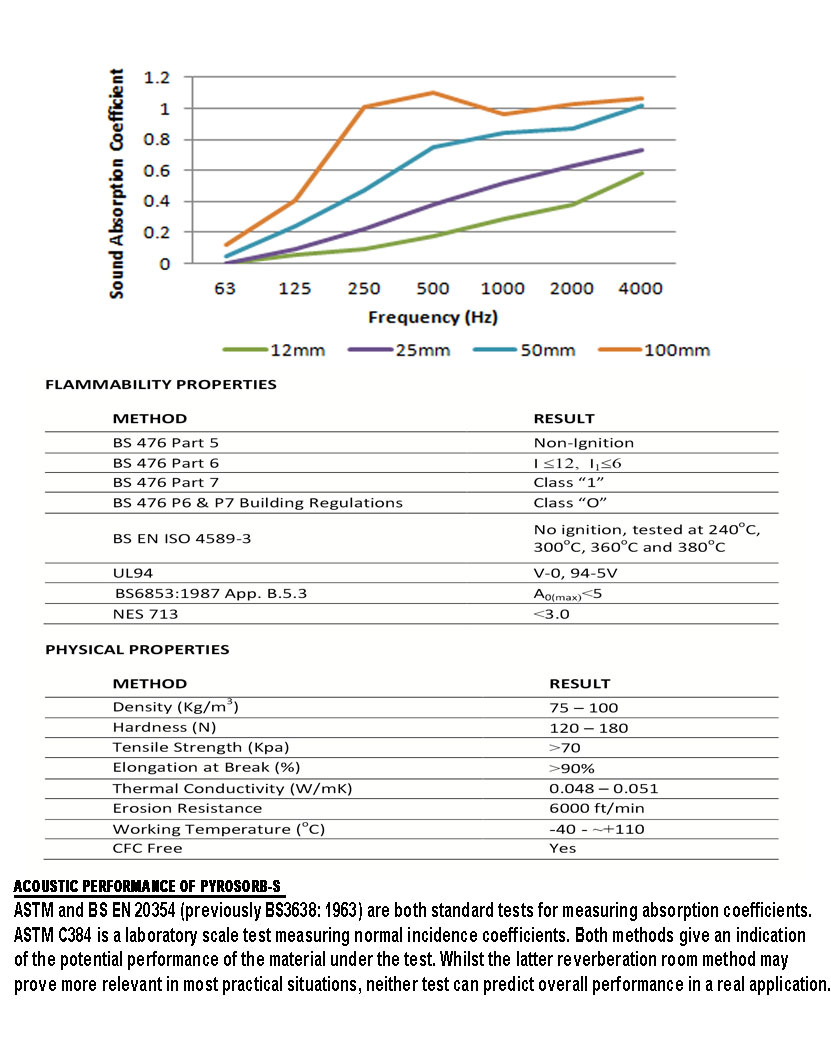
For applications requiring a Class 0 fire rating such as commercial buildings, public venues or projects subject to UK building regulations, please see our Pyrosorb-S Class 0 acoustic foam page for full specifications. Specification last reviewed March 2026.
Acoustic Foam Absorption Data
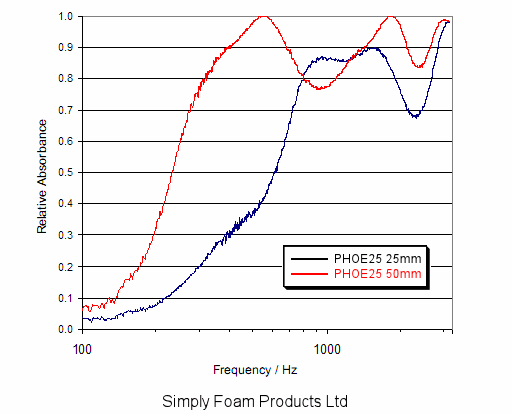
The chart below shows the sound absorption coefficient of our standard acoustic foam across the frequency spectrum. As thickness increases, absorption performance improves, particularly in the lower mid-frequency range. For low-frequency absorption we recommend pairing acoustic tiles with bass traps in room corners.
Acoustic Foam Tiles Frequently Asked Questions
Here are the questions we get asked most often about acoustic foam tiles and panels. If yours isn't covered, get in touch and we'll give you a straight answer.
What is the difference between flat and convoluted acoustic foam tiles?
This is probably the question we get asked more than any other. The short answer is that both work well, the difference is smaller than most people expect. Flat chamfered tiles have bevelled edges and a smooth face. They look tidy and professional on a wall. Convoluted tiles have the egg-crate profile you've probably seen in photos of recording studios. The peaks and valleys increase the surface area of the foam which helps it absorb slightly more sound energy across the mid to high frequency range. In a treated room you'd struggle to hear the difference between the two. Where convoluted tiles genuinely earn their place is in rooms with hard parallel walls where flutter echo is a real problem, the irregular surface breaks up reflections more aggressively. If you just want the room to sound better for recording or listening, either will do the job. If you want every last bit of performance, go convoluted.
How many acoustic foam tiles do I need?
A common mistake is assuming you need to cover every wall from floor to ceiling. You don't, and over-treating a room can actually make it sound worse, giving you a dead, lifeless acoustic that's unpleasant to work in. The goal is to reduce the primary reflection points, not eliminate all reflections entirely. For a typical home studio or spare room, covering around 25–40% of the wall surface is the sweet spot. In practice that usually means treating the two side walls at ear height, the wall behind the mix position, and the ceiling above the listening position if possible. Our small tiles (305 x 305mm) are 0.093sqm each, so a pack of 10 covers 0.93sqm. Our large tiles (600 x 600mm) are 0.36sqm each, so a pack of 6 covers 2.16sqm. If you tell us the dimensions of your room we can give you a more specific recommendation, just drop us a message.
Can acoustic foam tiles be installed on a ceiling?
Yes, and ceiling treatment is often more effective than people realise, the reflection point directly above your listening or recording position is one of the worst offenders for colouring the sound. For ceiling installation, spray contact adhesive is the most reliable method. The key things people get wrong are not letting the adhesive tack up enough before pressing the tile in place, and not pressing firmly enough when bonding, you need to hold the tile flat against the ceiling for a good 30 seconds. Our self-adhesive panel packs make ceiling installation noticeably easier since the adhesive is already applied and you don't need to manage a spray can overhead. Make sure the ceiling surface is clean and free of dust or paint flakes before you start, otherwise the bond won't hold.
How do I fix acoustic foam tiles to a wall?
Spray contact adhesive is the method we recommend and what most of our customers use. For bare brick or plaster, a heavy-duty contact spray works well. For plasterboard or wood, a carpet spray adhesive gives a strong bond without being quite so aggressive, useful if you might ever want to reposition tiles. The main thing to get right is application technique: spray both the back of the tile and the wall surface, let both surfaces tack for a minute or so, then press together firmly. Rushing this step is how tiles end up falling off a week later. If you're renting and don't want to use adhesive, some customers have had success with heavy-duty hook-and-loop tape, though we'd only recommend that for lighter tiles on smooth painted surfaces. We also supply spray adhesive directly if you need it.
Should I use acoustic tiles alone or do I also need bass traps?
For a lot of applications such as a podcast booth, a voiceover room, a home office where you just want to reduce echo on video calls, tiles alone will make a significant and noticeable improvement. But if you're doing serious music recording or mixing, tiles on their own will leave you with a problem. Low frequencies behave very differently to mid and high frequencies. They have much longer wavelengths and don't get absorbed by standard acoustic foam, they build up in room corners and create bass nodes that make it very hard to judge how your mixes will translate to other speakers. That's what bass traps are designed to address. The practical rule is: if accurate bass response matters to what you're doing, use both. If you just need the room to sound less echoey, tiles will get you most of the way there.
What is the difference between small and large acoustic foam tiles?
Beyond the obvious size difference, the choice is really about where you're putting them and how you want the installation to look. Small tiles (305 x 305mm, 12 x 12 inches) are easier to work with around obstacles such as light switches, sockets, windows, door frames. You can cut around things more precisely and fill awkward gaps. They're also more forgiving if your walls aren't perfectly flat. Large tiles (600 x 600mm, 24 x 24 inches) cover ground faster and tend to look cleaner on big open wall sections with fewer seams and more of a continuous treated surface. Both sizes are the same 40mm thickness so the acoustic performance per square metre is identical. It genuinely comes down to the space you're working with.
Why choose eFoam for your acoustic foam tiles?
We've been manufacturing acoustic foam in the UK for over 20 years. Everything you see on this page is made at our own factory in Bilston, West Midlands, not imported, not outsourced. That means tighter quality control, faster turnaround and foam that genuinely meets British fire safety standards.
When you buy from eFoam you're buying direct from the manufacturer. No markups from third-party retailers, no uncertainty about where the foam was actually made. Our team are always happy to help you choose the right product, call us free on 0800 0439990 (Monday to Friday, 8am–5pm) or send us a message.
Not ready to commit to a full order or unsure of which style/design to choose? Order a sample first, it's the best way to check density and design/finish before you buy.